

close
Choose Your Site
Global
Social Media

Views: 0 Author: Site Editor Publish Time: 2026-07-20 Origin: Site


Sourcing a reliable speaker wall bracket represents a high-stakes procurement decision. A sudden structural failure leads to damaged audio equipment, severe safety liabilities, and skyrocketing return rates. For B2B buyers, regional distributors, and system integrators, evaluating mounts requires looking closely past superficial spec sheets. The focus must remain firmly on load-bearing verification, actual hardware quality, and the factory's long-term manufacturing consistency. You simply cannot afford to trust marketing claims blindly when heavy electronics hang directly above people. This guide provides a comprehensive framework for evaluating structural integrity, end-user usability, and supplier reliability. We will show you exactly what specific materials, testing protocols, and hardware inclusions to demand before you commit your procurement budget to a bulk factory order.
Verify load capacity through documented weight-testing protocols, not just supplier claims.
Distinguish between residential and commercial use cases to determine the necessary articulation (tilt/swivel) and gauge of steel.
Scrutinize the included mounting hardware; cheap wall anchors are the primary cause of end-user failures and negative reviews.
Audit your speaker mount supplier for customization capabilities, packaging density, and compliance with international manufacturing standards.
Importers often view speaker brackets as low-tech accessories. This mindset creates massive blind spots in procurement. Buying strictly on unit price ignores the downstream consequences of inferior manufacturing. High-quality components directly protect your profit margins by reducing friction after the sale.
When a bracket fails, the financial impact extends far beyond the cost of the mount itself. Dropped speakers result in expensive liability claims and immediate brand damage. Retailers and distributors face grueling RMA (Return Merchandise Authorization) logistics. Processing a single return often wipes out the profit from ten successful sales. Furthermore, excessive return rates can cause major e-commerce platforms to suppress your product listings or suspend your seller account entirely.
You must align your product specifications with the actual use case of your target audience. Residential and commercial environments demand entirely different engineering approaches.
Residential: Home theater buyers prioritize aesthetics. They want low-profile designs sitting flush against the wall. Cable management features are essential to hide unsightly wires. Home users also prefer tool-less adjustment knobs for quick positioning.
Commercial: Public venues present harsher conditions. A commercial audio mount requires extreme load tolerances for high-traffic environments like restaurants, gyms, and retail stores. Tamper-resistant security screws prevent theft. Heavy-duty vibration isolation prevents the mount from loosening over time due to constant high-volume bass frequencies.
Consumer data paints a very clear picture. Buyers rarely complain about the metal bracket itself. Instead, poorly translated instruction manuals and stripped mounting screws drive over 80% of negative feedback. When end-users struggle to decipher installation steps, they install the product incorrectly. When cheap screws snap inside drywall studs, frustration peaks. Importers must solve these usability issues directly at the factory level by demanding upgraded hardware and localized manuals.
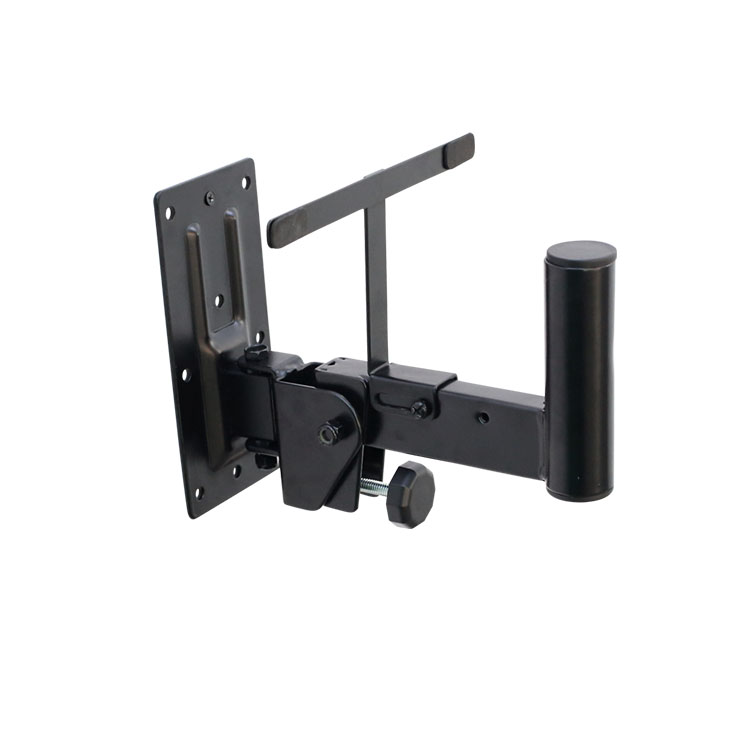
A bracket’s primary job is to hold expensive electronics safely above ground. You cannot verify structural integrity by merely holding a sample. You must investigate the metallurgical properties and the testing protocols used during production.
Look specifically for cold-rolled steel (SPCC) or die-cast aluminum. Cold-rolled steel provides excellent tensile strength for heavy loads, while aluminum offers a rust-proof, lightweight alternative for outdoor patios or marine environments. Always request the exact metal gauge thickness from the factory. Many budget suppliers secretly reduce metal thickness to save material costs.
Material Type | Primary Advantage | Best Use Case | Common Weakness |
|---|---|---|---|
Cold-Rolled Steel (SPCC) | High tensile strength and rigidity | Large bookshelf speakers, commercial venues | Vulnerable to rust if powder coating flakes |
Die-Cast Aluminum | Lightweight and highly corrosion resistant | Outdoor venues, marine installations, patios | Can crack under sheer impact stress |
ABS Plastic (Reinforced) | Low cost and moldable into complex shapes | Small satellite speakers under 5 lbs | Degrades and becomes brittle over time |
Do not accept standard nominal weight claims at face value. Require hard evidence of weight capacity testing. Industry best practice requires testing a heavy duty speaker mount at three to four times its stated nominal weight. If a bracket claims a 50 lb capacity, the factory should provide test reports showing it holding 150 lbs for 24 hours without permanent deformation.
Next, evaluate the locking mechanisms holding the articulating arm in place. Plastic tension knobs degrade and strip over time. Gravity eventually forces the speaker to droop. Metal-on-metal locking gears, commonly known as rosette teeth, prevent sagging entirely by physically locking the tilt angle into place.
Speakers generate intense kinetic energy. This vibration travels directly into the bracket. Check your factory samples for the inclusion of high-density EVA foam pads or thick rubber isolation rings. These small additions provide massive value. They prevent annoying rattling sounds during heavy bass tracks and protect wooden speaker cabinets from getting scratched by bare metal clamps.
Audio professionals know speaker placement drastically alters sound quality. An adjustable mount gives users the flexibility to aim sound waves exactly where they want them. The mechanical design dictates how easily users can achieve optimal acoustics.
An effective adjustable speaker bracket must offer specific pan (swivel) and tilt ranges. A standard tilt range of +/- 15 degrees usually suffices for home theaters, while a 180-degree swivel allows for corner mounting. Check the fluidity of the hinges under a full load. Joints should move smoothly without requiring excessive force. If the joints bind or squeak during adjustment, the factory likely skipped the internal lubrication process or used improperly sized washers.
Assess how the bracket physically attaches to the speaker and the wall. Compatibility drives sales volume.
Universal vs. Dedicated: Universal clamping mechanisms grip the sides of bookshelf speakers, making them perfect for users who refuse to drill holes into expensive wood cabinets. Conversely, dedicated mounts use standard threaded inserts (like M5 or M6 bolts) or keyhole slots. Dedicated mounts offer a much cleaner look and greater security for commercial installations.
Wall Type Adaptability: Ensure the wall backplate footprint remains wide enough to distribute weight safely. A narrow backplate concentrates pressure, which can easily crack standard drywall. A wider base plate allows installers to hit wooden wall studs reliably or spread the load evenly across brick and concrete surfaces.
Evaluate whether the bracket allows for concealed speaker wire routing. Bare wires hanging down a wall ruin the aesthetic of modern smart homes and professional A/V integrations. The best designs feature hollow articulating arms or snap-on plastic covers. This allows installers to run thick gauge speaker wire directly from the wall plate, through the mount, and into the speaker terminals invisibly.
The fastest way to ruin a perfectly engineered metal bracket is to ship it with terrible hardware. Importers frequently ignore the accessory bag. You must treat the hardware pack as a critical component of the overall product assembly.
Assume standard factory-included wall anchors are entirely inadequate for drywall installations unless specified otherwise. Factories usually provide cheap, smooth plastic anchors meant for solid masonry. When users put these in drywall, they pull out instantly under load. Specify high-tensile lag bolts and heavily ribbed, Fischer-style nylon wall plugs in your official Bill of Materials (BOM). Upgrading the hardware pack costs pennies per unit but prevents thousands of dollars in returns.
Review the factory's default installation manuals carefully. Ambiguous instructions lead directly to improper installation. Factories often use poorly translated text and tiny, confusing diagrams. Throw the default manual away. Plan to localize and rewrite the manuals completely. Use clear, step-by-step visual diagrams. Highlight necessary drill bit sizes prominently. Add warning labels reminding users to mount heavy setups directly into wooden studs.
Ocean freight punishes cardboard boxes. You must audit the packaging design for transit safety. Loose hardware rolling around inside a box will scratch the bracket's premium powder coating before it ever reaches the customer.
Request an inner blister pack or thick polybag for all hardware components.
Ensure the bracket arms remain isolated from one another using custom cardboard inserts or molded EPE foam.
Perform a drop test on the final retail box from a height of three feet onto concrete to verify the internal packaging absorbs the impact properly.
Finding a factory is easy. Finding a long-term manufacturing partner requires due diligence. You must look beyond Alibaba profiles and assess their true engineering and quality control capabilities.
Determine early on if the factory primarily acts as a trading company or an actual manufacturer. Can they handle both standardized off-the-shelf designs and custom tooling? A true manufacturer owns in-house stamping machines, welding stations, and powder coating lines. Ask for video tours of their production floor if you cannot visit in person. Factories relying heavily on external subcontractors often suffer from unpredictable lead times and fluctuating quality.
If you plan on developing an exclusive OEM speaker bracket, verify the supplier's capacity for customization. True OEM partners offer flexibility. They should accommodate custom powder coating colors, like matte white for modern interiors or textured black for stage setups. Verify their ability to provide private-label branding through durable silk-screening or precise laser etching. Additionally, ask if they can modify custom backplate dimensions to fit specific regional wall stud spacings (e.g., 16-inch center-to-center for North America).
Look for suppliers who welcome transparency. Reliable factories readily allow third-party pre-shipment inspections from agencies like SGS or TÜV. Ask about their inbound raw material checks. Do they test the tensile strength of steel rolls before stamping? Do they verify the chemical composition of their powder coat paint? Factories with rigorous inbound QC catch defects long before they assemble your final product.
Never place a bulk order without testing physical samples first. Once you receive production samples, put them through a harsh independent evaluation.
Perform your own independent load tests by hanging dead weight from the extended arm.
Scratch the surface with a coin to check for powder coat flaking or poor paint adhesion.
Test the thread tolerances on every single screw hole. If screws go in crooked or feel excessively tight, the factory has poor tapping machinery.
Sourcing brackets remains a strict exercise in risk mitigation. Success relies heavily on demanding structural proof rather than accepting verbal promises. By upgrading included hardware, prioritizing articulation fluidity, and validating factory claims through rigorous physical sample testing, you protect both your margins and your customers.
Your immediate next step is to formalize this process. Build a standardized QC checklist based on material gauge requirements, hardware quality expectations, and instruction manual clarity. Send this explicit checklist to your suppliers when requesting your next batch of factory samples to establish your quality baseline immediately.
A: Request their internal testing reports or require a third-party laboratory load test. A credible standard is testing the bracket at 3 to 4 times its advertised weight capacity for a sustained period without structural deformation. Do not accept claims based solely on theoretical material strength.
A: MOQs vary significantly among manufacturers. Typical thresholds for custom tooling or proprietary metal designs start between 1,000 and 3,000 units. If you only require off-the-shelf private labeling (like adding your logo and custom packaging), factories may accept initial orders of just 500 units.
A: It depends heavily on your target market. Clamping brackets are highly versatile for residential consumers who don't want to drill into their wooden speaker cabinets. Conversely, screw-in mounts using threaded inserts are vastly preferred for secure, heavy-duty commercial audio installations.
A: Ensure the inclusion of high-quality mounting hardware, specifically heavy-duty drywall anchors and lag bolts. Furthermore, completely rewrite the factory installation manual with clear, professional diagrams. Poor installation, driven by confusing instructions and cheap wall plugs, remains the leading cause of bracket failure.
