

close
Choose Your Site
Global
Social Media

Views: 0 Author: Site Editor Publish Time: 2026-10-16 Origin: Site


Poorly executed mounting hardware carries steep financial and reputational risks for any audio-visual brand. A sudden load-bearing failure invites severe legal liability and public relations disasters. Meanwhile, subtle structural flaws introduce excess vibration, severely degrading acoustic fidelity. You simply cannot afford to overlook the engineering behind your installation hardware. Transitioning to an Original Design Manufacturer acts as a strategic move. It aggressively accelerates your time-to-market. You get to leverage specialized engineering teams already experienced in complex audio-visual ecosystems. This eliminates steep internal learning curves. This article provides a transparent, end-to-end roadmap of the production cycle. We will guide you through crucial engineering phases, testing protocols, and mass production standards. You will establish clear evaluation criteria for shortlisting manufacturing partners capable of delivering both safety and performance.
You must understand the fundamental difference between OEM and ODM manufacturing models. OEM means build-to-print. You supply every engineering blueprint. The factory simply manufactures it according to your exact specifications. ODM stands for concept-to-build. You supply the performance goals and aesthetic desires. The manufacturer handles all underlying engineering. You should choose the ODM route when internal engineering bandwidth feels tight. Fast time-to-market often demands this path. Developing a custom ODM speaker bracket offloads heavy technical lifting to seasoned experts.
People often wrongly assume hardware brackets act as simple bent metal. This ignores vital acoustic physics. A rigid structure must actively mitigate unwanted resonance. It must support very specific acoustic dispersion angles safely. Poor rigidity introduces audible rattles. It distorts low-frequency output significantly. Wall coupling effects can ruin a premium speaker cabinet's sound profile. Good engineering prevents structural vibration transfer entirely.
You must establish firm baseline requirements early in the process. Detail your target unit costs upfront. Define the maximum load-bearing weight clearly. Clarify the environmental durability expectations immediately. Outdoor installations require strict weatherproofing protocols. Indoor units prioritize sleek aesthetic integration. Establish these criteria before sourcing any suppliers.
Common Mistakes During Requirement Gathering:
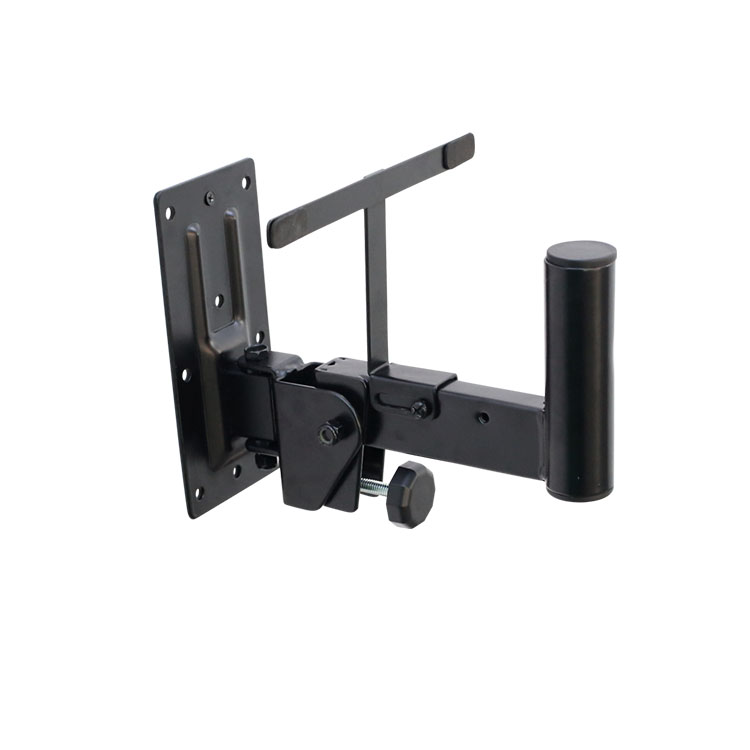
Initial requirement gathering requires deep collaboration. You must translate acoustic specifications into industrial design concepts. A beautiful metal shell means nothing if it blocks rear bass ports. It fails if it pinches routing cables. We constantly balance visual appeal against absolute functional necessity. The design must accommodate real-world installation scenarios.
Engineers evaluate various alloys and polymers meticulously. They select materials based on tensile strength and overall weight profiles. Heavy cabinets demand robust metals. Lightweight satellite speakers allow for engineered plastics. Choosing the wrong material guarantees field failures.
Material Comparison Chart for AV Hardware
| Material Type | Tensile Strength | Weight Profile | Best Application Scenario |
|---|---|---|---|
| Cold-Rolled Steel | Very High | Heavy | Large venue monitors, heavy subwoofers |
| Aluminum Alloys | Moderate to High | Lightweight | Premium aesthetic installs, marine environments |
| High-Impact Polymers | Moderate | Very Light | Small indoor satellite speakers, smart home devices |
Design for Manufacturability eliminates production bottlenecks early. Engineers adjust structural designs to reduce factory scrap rates. They optimize every curve for specific manufacturing processes. A solid AV mount might use stamping, die-casting, or extrusion. DFM aligns the design geometry to the cheapest, fastest fabrication method. Removing unnecessary undercuts saves thousands in mold costs.
We rely heavily on advanced 3D Modeling software. Engineers run comprehensive Finite Element Analysis (FEA) simulations. FEA accurately predicts mechanical stress points. It highlights vibration resonance zones before tooling ever begins. You avoid costly physical prototyping mistakes this way. We simulate worst-case loading scenarios digitally.
Rapid prototyping validates your physical fit and function. We produce CNC-machined or high-resolution 3D-printed samples. You physically test these samples against the actual speaker cabinet. Installers check tool clearance for screwdrivers and hex keys. Minor dimensional tweaks happen precisely here.
Transitioning to hard tooling requires patience and capital. Expect realistic fabrication timelines spanning 30 to 60 days. Complex die-casting molds take longer than simple stamping dies. Clarify tooling ownership terms before releasing payment. You must control your intellectual property.
Your product must never fail catastrophically. Proving safety requires extreme mechanical stress tests. A reliable ODM speaker mount must exceed standard safety margins comfortably. Global industry standards demand 3x to 5x nominal weight capacity. Engineers document ultimate tensile failure limits meticulously. We apply dynamic cyclic loading to simulate years of micro-vibrations.
Harsh weather destroys unprotected metal rapidly. We use rigorous salt spray chambers to accelerate aging. This testing proves corrosion resistance for demanding outdoor installations. We typically run 96-hour to 500-hour ASTM B117 salt fog tests. Vibration table testing ensures absolute acoustic neutrality across all frequency bands.
Global retail markets demand documented safety compliance. We map out UL, CE, RoHS, and TUV regulatory requirements early. Passing these standards requires precise material tracking. Certified independent labs provide the final stamp of approval. Lacking these certifications blocks major distribution channels immediately.
New Product Introduction (NPI) requires a dedicated pilot run. We execute a small-batch production run carefully. Technicians dial in the final assembly lines. Workers construct and finalize custom welding jigs. Factory managers calibrate surface finishing processes precisely. This includes checking powder coating thickness and verifying anodizing color uniformity.
Scaling production introduces logistical challenges. Managing Minimum Order Quantities (MOQs) stresses many procurement teams. We align manufacturing schedules against raw material availability realities. You balance inventory carrying costs against higher volume discounts. Stamping requires higher MOQs to offset setup times. CNC machining allows for lower initial batch volumes.
Implementing standardized inspection protocols protects your brand reputation. We establish clear Acceptable Quality Limit (AQL) standards. Random sampling prevents defective batches from shipping.
Essential End-of-Line QC Protocols:
You must prioritize engineering depth over pure production capacity. Massive factories mean nothing without smart designers. Assess whether the facility employs dedicated structural engineers full-time. Do they merely outsource critical design phases to third parties? Ask them for specific case studies highlighting past structural problem-solving. True experts love discussing complex engineering hurdles they overcame.
Trustworthy partners provide raw testing data transparently. Request unedited tensile strength reports during your audit. Ask for daily salt spray logs and FEA simulation files. Verbal assurances hold zero weight in hardware manufacturing. Demand documented proof of their quality assurance claims.
Intellectual property theft ruins innovative businesses quickly. Establish clear IP protection contracts during the initial decision stage. These terms remain strictly non-negotiable. Ensure contracts explicitly state who owns the custom steel molds. Enforce strict non-compete clauses covering your developed designs. The factory must never sell your custom brackets to competitors.
Evaluate their underlying supply chain resilience. Global disruptions happen frequently and unpredictably. Audit their raw material sourcing networks closely. Gauge their vulnerability to sudden macroeconomic shocks. Localized material sourcing often prevents catastrophic shipping delays. A resilient partner absorbs market volatility better.
Best Practices for Supplier Audits:
Successful hardware projects rely entirely on upfront engineering and rigorous testing. Design for Manufacturability remains your strongest tool for cost control. Uncompromising load testing prevents disastrous liability claims down the road. You mitigate immense risk by demanding transparency from your manufacturing partner.
We advise procurement and product managers to act systematically. Formalize your Technical Requirement Documents (TRD) before conducting initial supplier outreach. Vague requests yield inaccurate quotes and misaligned expectations. Document your weight limits, environmental needs, and aesthetic goals clearly.
Do not leave your audio-visual hardware to chance. Reach out today to request a comprehensive technical consultation. Schedule a professional DFM review for your specific mounting hardware project. Secure your product's safety and profitability by partnering with true engineering experts.
A: A standard project takes roughly 10 to 14 weeks. Expect 2 to 4 weeks for initial design and DFM analysis. Tooling fabrication and rapid prototyping consume 4 to 6 weeks. Finally, mass production requires another 4 weeks after prototype approval.
A: It depends on the contract. If you pay fully for custom molds, you should retain exclusive IP and tooling ownership. If you modify an off-the-shelf ODM design, the manufacturer typically retains the core IP.
A: Standard industry MOQs range from 500 to 2,000 units. Stamped steel components usually require higher volumes (1,000+ units) to offset die setup times. CNC-machined or extruded aluminum designs can accommodate lower MOQs.
A: Yes. Full-service manufacturers manage end-to-end solutions. They provide custom white-label packaging, print user manuals, and coordinate third-party lab certifications like UL or CE on your behalf.
