

close
Choose Your Site
Global
Social Media

Views: 0 Author: Site Editor Publish Time: 2026-09-23 Origin: Site


In commercial AV installations, system failures rarely happen at the speaker—they happen at the mount. A falling speaker poses severe safety hazards. Unlike residential setups, commercial environments demand strict adherence to complex building codes. Conference rooms, bustling retail spaces, and live venues require intense liability mitigation. They also demand precise acoustic alignment for clear sound delivery. Selecting the right AV speaker mounting bracket is therefore a critical engineering and procurement decision. Getting this choice wrong leads to structural damage or poor audio performance. This guide breaks down how you should evaluate structural realities and assess various bracket categories. You will learn how to specify the exact hardware needed for a secure, fully compliant installation. We will explore everything from safe working loads to environmental durability.
You cannot mount heavy audio equipment without understanding the underlying architecture. The structural substrate dictates your anchoring strategy entirely. Hollow drywall presents the highest risk for commercial installations. You cannot rely on standard drywall anchors for dynamic audio loads. Drywall installations require pre-installed blocking plates or direct attachment to structural studs. Masonry and concrete surfaces offer superior holding power. However, they require specialized wedge anchors or heavy-duty tapcons. You must ensure the concrete depth accommodates the required anchor embedment. Open-ceiling steel trusses present a different challenge. You cannot drill into structural steel beams without engineer approval. Instead, you must use load-rated beam clamps or specialized truss adapters. Always verify the load-bearing capacity of the substrate before selecting your hardware.
Audio hardware placement relies heavily on acoustic blueprints. You must map your bracket placement directly against these acoustic models. Proximity to reflective surfaces drastically alters sound quality. Placing a speaker too close to a side wall creates unwanted acoustic reflections. These reflections muddy speech intelligibility in boardrooms. You also need to account for required dispersion angles. Hospitality venues require uniform audio coverage across wide seating areas. Your bracket must provide enough mechanical clearance to achieve these specific angles. If a bracket limits the pan or tilt range, you will create acoustic dead zones. Check the dimensions of the speaker cabinet against the wall clearance provided by the bracket.
You must clearly define the physical environment before specifying mounting hardware. Indoor climate-controlled rooms allow for standard steel components. However, challenging environments require specialized materials. High-humidity areas like indoor pools degrade standard hardware rapidly. Outdoor patios expose mounts to rain, wind, and extreme temperature fluctuations. Industrial facilities often contain corrosive airborne chemicals. In these scenarios, you must specify IP-rated, galvanized, or powder-coated brackets. These finishes prevent structural degradation caused by corrosion. Rust weakens load-bearing joints over time. A compromised joint will eventually fail under the continuous vibration of the speaker. Always match the environmental rating of the bracket to the surrounding conditions.
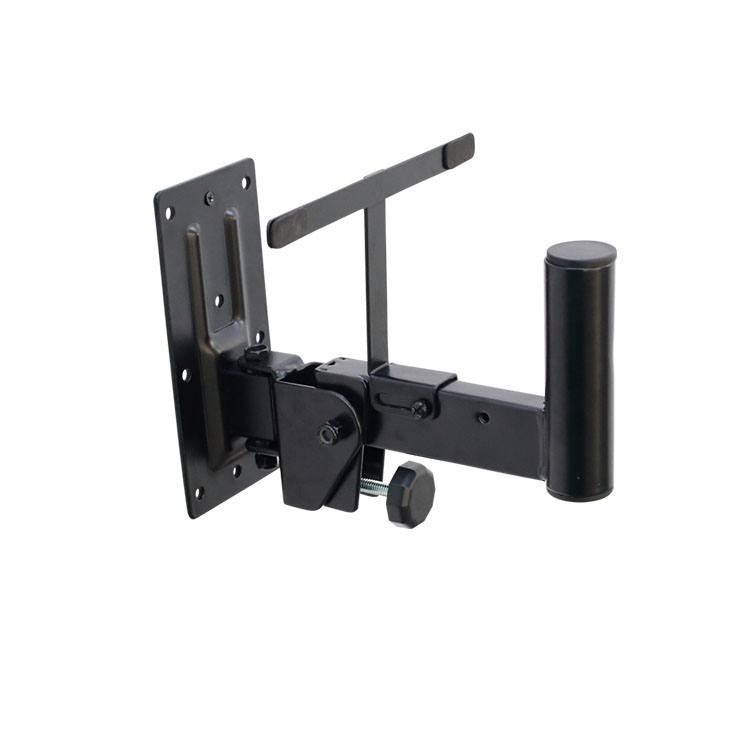
Articulating wall mounts serve as the standard for most surface-mount applications. They are essential when you require highly directional audio. These mounts must handle dynamic loads generated by heavy bass frequencies. You should focus heavily on their ability to maintain precise pan and tilt adjustments. A quality articulating mount allows integrators to aim the sound exactly where it needs to go. This flexibility solves complex coverage issues in oddly shaped rooms. They typically feature a base plate attached to the wall and an adjustable arm connected to the speaker. You must ensure the articulating joints lock securely to prevent unwanted movement.
Large-footprint commercial spaces often rely on distributed audio systems. Ceiling and pendant brackets are necessary for these environments. Retail stores and airport concourses use them to provide even sound pressure levels. When hanging speakers from the ceiling, vibration isolation becomes critical. You do not want bass frequencies rattling the drop-ceiling grid. You must specify brackets designed to isolate the speaker from the surrounding architecture. Additionally, drop-ceiling installations require grid-tie reinforcements. You must anchor the speaker bracket directly to the structural deck above the drop ceiling. Relying solely on the acoustic tile or the aluminum grid violates building safety codes.
Architecturally sensitive spaces often restrict the use of bulky hardware. High-traffic corridors also require strict adherence to ADA compliance. The Americans with Disabilities Act mandates that objects cannot protrude excessively into walkways. Low-profile and flush mounts solve these problems. They keep the speaker tight against the wall, minimizing the physical footprint. However, you must note a major trade-off. These an AV speaker mount offers minimal to zero acoustic aiming flexibility. You cannot angle the speaker toward a specific listening area. You should only specify flush mounts when aesthetics or ADA codes override directional acoustic requirements.
Commercial hardware relies on strict engineering standards. You must understand the concept of the safety factor. Industry best practices recommend maintaining a 5:1 or even a 10:1 safety ratio for commercial loads. This means if a speaker weighs 20 pounds, the mount should ideally withstand 100 to 200 pounds of force before yielding. You should never load a bracket to its absolute maximum advertised capacity. Dynamic forces, such as continuous vibration or seismic events, multiply the stress on the mounting points. Operating at the maximum limit leaves no margin for error. Always calculate the total weight of the speaker and the necessary cabling. Then, ensure this combined weight falls well below the stated safe working load.
| Material Type | Primary Characteristics | Best Commercial Applications | Common Limitations |
|---|---|---|---|
| Stamped Steel | Cost-effective, relatively lightweight, flexible. | Small background music speakers, paging horns. | Prone to bending under heavy loads; transmits resonance. |
| Die-Cast Aluminum | Rigid construction, rust-resistant, excellent resonance dampening. | Medium-to-large point-source cabinets, outdoor venues. | Can be brittle under extreme impact forces. |
| Heavy-Gauge Steel | Maximum tensile strength, highly durable, heavy. | Heavy line arrays, large subwoofers, theatrical audio. | Requires robust structural backing; susceptible to rust if unpainted. |
The manufacturing material dictates both strength and acoustic performance. Stamped steel provides a cost-effective solution. It works perfectly fine for lighter loads like small paging speakers. However, stamped steel can flex under the weight of larger cabinets. Die-cast aluminum and heavy-gauge steel offer superior performance for demanding environments. These materials are essential for heavy line-array or point-source cabinets. More importantly, rigid materials help with resonance reduction. A flimsy bracket acts like a tuning fork, vibrating along with the speaker. This unwanted vibration colors the sound and reduces audio clarity. Heavy-gauge materials absorb these vibrations, ensuring the audio output remains pristine.
You must carefully evaluate how the bracket locks into place. Many cheaper mounts rely on friction-lock joints. A friction joint uses a tightened bolt pressing against a smooth surface to hold the angle. These are highly prone to sagging over time under heavy vibration. The constant thumping of low-frequency audio micro-loosens the bolt. Conversely, professional mounts utilize interlocking gear teeth. When you tighten a gear-tooth joint, the metal teeth mesh together physically. This mechanical interlock ensures the angle remains permanently fixed post-commissioning. Gravity and vibration cannot overcome the locked teeth. You should always specify geared mechanisms for heavy speakers or high-vibration environments.
Hardware costs represent only a fraction of an installation budget. On-site labor hours drive up expenses significantly. You should prioritize brackets designed to save integrators time. Integrated wire management channels hide cables cleanly, eliminating the need for exterior zip ties. Pre-drilled VESA or standardized mounting patterns remove the need for custom fabrication. The most valuable feature is a two-piece "slide-and-lock" design. With this design, the integrator mounts the wall plate first. Then, they attach a mating plate to the speaker. Finally, they simply slide the speaker onto the wall plate and lock it. This eliminates the struggle of holding a heavy speaker with one hand while threading bolts with the other.
Mounting heavy equipment to unsupported drywall is a recipe for disaster. The drywall will eventually crumble, sending the speaker crashing down. This is the most common failure point in commercial audio deployments. You must address this during the framing stage whenever possible. Pre-installation blocking involves installing plywood or metal plates between the wall studs. This provides a continuous, solid surface for your anchor bolts. If you enter a finished space without blocking, you must use spanning plates. A spanning plate attaches across two separate wall studs on the outside of the drywall. You then mount the speaker bracket directly to the center of the spanning plate.
Skipping redundant safety measures creates massive liability. Building inspectors and commercial insurance policies strictly mandate secondary safety cables. A primary joint failure or severe seismic activity can snap a mounting bracket. If this happens, a steel safety cable catches the speaker before it hits the ground. You must anchor this safety cable to an independent structural point. Do not attach the safety cable to the speaker bracket itself. If the bracket pulls out of the wall, the cable will fail with it. The cable must connect the speaker chassis directly to a building stud or concrete ceiling deck.
Acoustic droop ruins carefully modeled sound designs. Continuous low-frequency vibration causes poorly machined brackets to slowly tilt downward. When a speaker points at the floor instead of the audience, high frequencies vanish. Intelligibility drops drastically, prompting complaints from the client. Fixing this issue requires costly truck-rolls for readjustment. Integrators have to bring in ladders or scissor lifts just to re-aim the speakers. You can completely avoid acoustic droop by specifying high-quality hardware from the start. Choose brackets with high weight tolerances and locking gear teeth. Preventative procurement stops expensive maintenance trips later.
When searching for a reliable surface-mount solution, you need a benchmark for quality. We introduce the JYSP-120 speaker wall bracket as a practical standard. This unit excels in commercial scenarios requiring reliable articulation. It bridges the gap between heavy-duty industrial mounts and aesthetically pleasing commercial designs. You can deploy it in corporate boardrooms, large retail floors, and hospitality venues. Its design accommodates the specific directional needs of modern point-source speakers. When your project demands precise audio coverage without compromising safety, this bracket serves as an excellent foundational choice.
The JYSP-120 fulfills essential baseline requirements for commercial engineering. First, it features clear, documented load limits that allow for proper safety factor calculations. Second, it utilizes robust material construction designed to dampen cabinet resonance. You will not experience the metallic rattling common with cheaper alternatives. Third, it provides a highly secure pan and tilt adjustment mechanism. This mechanism locks down tightly, making it suitable for medium-to-large commercial speaker cabinets. It handles the continuous vibration of background music and paging systems without loosening. This technical stability ensures the audio system performs exactly as the acoustician intended.
You should guide your buyers using sound shortlisting logic. First, match the bracket’s mounting footprint exactly to your specific speaker hardware. Verify that the hole patterns align perfectly without requiring field modifications. Modifying a bracket in the field often voids its safety rating. Next, evaluate the weight ratio. We strongly advise ensuring the speaker's weight comfortably sits within 50-70% of the bracket's maximum limit. This provides a generous buffer for dynamic forces and ensures optimal stability. By adhering to this margin, you protect the installation against unexpected mechanical stress. The JYSP-120 accommodates this shortlisting logic easily for most standard commercial cabinets.
Procuring commercial mounting hardware goes far beyond simply matching weight limits. You must finalize your procurement logic around structural realities and environmental demands. Always prioritize structural safety above all else. Emphasize exact acoustic aiming capabilities to guarantee system performance. Seek out integrator-friendly designs that reduce expensive on-site labor hours. Do not sacrifice these critical elements for upfront hardware savings. A cheap bracket often results in catastrophic failure or costly maintenance visits. We advise technical buyers and integrators to audit their acoustic design layouts carefully. Verify your structural blueprints with the construction team. Finally, check local seismic building codes before generating your final bill of materials. Taking these steps ensures a flawless, safe, and high-performing audio installation.
A: The technical standard requires a 5:1 or greater safety ratio for overhead and wall loads in commercial spaces. This means the bracket must be capable of supporting five times the actual weight of the speaker before reaching its yield point. This buffer accounts for dynamic forces, vibrations, and potential seismic activity.
A: Yes, absolutely. Secondary safety cables are essential for liability mitigation and act as a structural fail-safe. Building inspectors and commercial insurance policies usually mandate them. The cable must anchor the speaker directly to the building structure, independent of the primary bracket, to comply with strict safety codes.
A: You prevent sagging by selecting brackets equipped with interlocking gear teeth rather than smooth friction joints. Gear teeth lock physically, resisting vibration. Additionally, you should never exceed 70% of the stated maximum load limit. Keeping the weight well below the maximum capacity reduces stress on the articulating joints.
